


High-resolution direct laser writing nanolithography enabled by oxidation-mediated corrosion selectivity in N-doped Sb heat-mode resists

Abstract
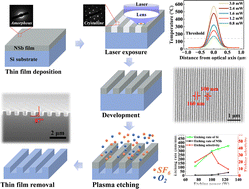
Direct laser writing lithography provides a maskless and cost-effective approach to nanofabrication, yet its resolution is fundamentally limited by optical diffraction. This work demonstrates sub-diffraction-limit nanolithography and dry etching using nitrogen (N)-doped antimony (Sb) thin films. The NSb film acts as a positive-tone resist, achieving a development selectivity of 6.1 in tetramethylammonium hydroxide. Electrochemical measurements reveal that the thermally exposed film exhibits a higher corrosion current, lower potential, and lower charge transfer resistance compared to the as-deposited film, corresponding to an increased corrosion rate. This selectivity is primarily due to the formation of the Sb crystal phase and a higher degree of oxidation in the exposed film, which renders it more prone to corrosion. In contrast, the uniform dispersion of N and Sb atoms in the as-deposited film helps suppress the oxidation and dissolution of Sb to some extent. By confining the heat conduction within the heat affected zone, high-resolution nanostructures with a minimum feature size of 60 nm and a minimum period of 160 nm have been realized in NSb thin films. Moreover, the NSb film shows excellent etching resistance, with a maximum Si-to-film etching selectivity of 34.0 under SF6/O2 plasma. The etched Si structures display steep sidewalls and low line-edge roughness. This etching selectivity is attributed to the formation of non-volatile SbOx and SbFx compounds under SF6/O2 plasma, which protect the NSb film from further etching while Si is readily removed. Finally, a Si nanohole array is fabricated to demonstrate an anti-reflection function, highlighting its potential for use in photovoltaic solar cells.
- This article is part of the themed collection: Journal of Materials Chemistry C HOT Papers
 Please wait while we load your content...


