


DFT exploration of p-type conductivity and fully visible light transparency in chalcopyrite AgMCh2 (M = Al and Ga; Ch = S, Se, and Te)

Abstract
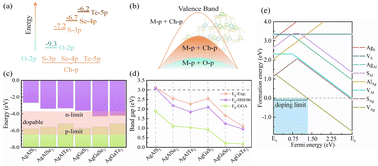
Transparent conducting materials (TCMs) are essential in the modern optoelectronic field. Currently, the commercially and extensively used TCMs are dominated by n-type candidates, while high-performance p-type counterparts are rare. Through theoretical calculations, we find that among the chalcopyrite AgMCh2 series (M = Al and Ga; Ch = S, Se, and Te), only AgAlS2 meets the requirements for a ductile, visible-light transparent, and p-type electrical candidate. When the sample thickness reaches 100.0 nm, AgAlS2 preserves high visible light transmittance (above 80.0% along the x(y)-direction). Defect analysis confirms that the p-type electrical conductivity is dominated by the intrinsic defect Ag vacancy (VAg). As an exceptional p-type electrical conducting candidate, the hole mobility can reach 20.7 cm2 V−1 s−1, and its p-type electrical conductivity at room temperature attains 103 S m−1 with a hole density of 1019 cm−3. Considering the limitations of equilibrium preparation schemes, the nonequilibrium preparation strategies are essential to fabricate intrinsic defects in AgAlS2. This work provides a key insight into its properties, expands the applications of AgAlS2, and paves a new way for the design and exploration of the fully visible light transparent and p-type electrically conductive systems.
- This article is part of the themed collection: Journal of Materials Chemistry C HOT Papers
 Please wait while we load your content...


