


An integrated high-throughput screening framework for perovskite light-emitting diode passivators based on machine learning
 *a
and
Tingting
Shi
*a
*a
and
Tingting
Shi
*a
Abstract
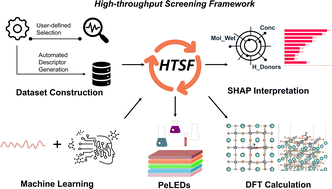
Efficient passivator screening is essential for mitigating defects in perovskite optoelectronic devices. Conventional trial-and-error methods remain inefficient and resource-intensive. Although machine learning (ML) offers a promising alternative, existing models based on single-lab datasets often exhibit poor generalizability and lack the capability for high-throughput screening. To tackle these challenges, we propose a high-throughput screening framework (HTSF) with a novel Gaussian-noise-enhanced training strategy for passivator research. By automating descriptor generation, enabling user-defined selection, and extracting values automatically, HTSF significantly streamlines dataset construction and improves the efficiency of high-throughput screening. To ensure model interpretability, SHAP (SHapley Additive exPlanations) is employed to quantify feature importance. The optimal model achieves a validation R2 score exceeding 0.90, demonstrating strong robustness. We applied the framework to evaluate 70 candidate passivators, and the ML predictions show strong alignment with subsequent density functional theory calculations. This work presents a scalable and interpretable ML-based approach for passivator discovery, paving the way toward accelerating the identification of functional materials prior to experimental validation.
- This article is part of the themed collection: Journal of Materials Chemistry C HOT Papers
 Please wait while we load your content...


