


Improved performance of organic single-crystal thin-film transistors via contact doping with a high electron-affinity dopant

Abstract
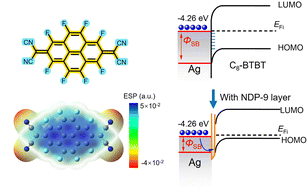
Organic single-crystal devices are regarded as the pinnacle of organic electronics in terms of performance, yet they are significantly hindered by the high Schottky barriers at metal-semiconductor contacts. Contact doping represents an effective strategy to mitigate Schottky barriers and boost device performance, and its success hinges on the use of a dopant with a high electron affinity (EA). Here, we introduce a potent p-type molecular dopant, 2-(7-dicyanomethylene-1,3,4,5,6,8,9,10-octafluoro-7H-pyrene-2-ylidene)-malononitrile (NDP-9), featuring multiple CN electron-withdrawing groups. This design endows NDP-9 with a notably higher EA than previously reported contact dopants for organic thin-film transistors (OTFTs). By incorporating the high-EA NDP-9 as an interfacial interlayer, the Schottky barrier height (ΦSB) is reduced from 0.25 eV to 0.05 eV, while simultaneously filling interfacial trap states. Consequently, OTFTs based on organic single-crystalline films exhibit a high mobility of 13.08 cm2 V−1 s−1, a low subthreshold swing (SS) of 187 mV dec−1, and enhanced long-term bias stress stability. Moreover, this straightforward method facilitates the fabrication of large-area device arrays, achieving an average mobility of up to 12.89 cm2 V−1 s−1 with high uniformity (relative variance of 5.07%). This study underscores the critical role of high-EA dopants in optimizing the electrical performance of OTFTs, offering a universal pathway for advancing high-performance organic electronics.
- This article is part of the themed collection: Journal of Materials Chemistry C HOT Papers
 Please wait while we load your content...


