


Efficient broadband light sensing with anisotropic Sb2S3 based thin film heterojunction photodetectors under self-driven conditions

Abstract
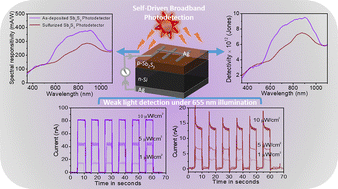
Sb2S3 is gaining attention due to its optoelectronic properties required for photovoltaic applications including photodetectors. However, Sb2S3 based photodetectors were limited to UV to visible light detection due to its wide energy bandgap of 1.7 eV. Broadband (UV-vis-NIR wavelength) detection is feasible by forming a wide bandgap p-type Sb2S3- and a narrow bandgap n-type semiconductor-based heterojunction device. This work first evaluates the structural, optical and electrical properties of Sb2S3 films prepared by thermal evaporation and post-sulfurization. Subsequently, n-Si/p-Sb2S3 photodetectors were fabricated using the as-deposited and post-sulfurized Sb2S3 films to explore their broadband light sensing characteristics. The photodetectors were tested in a broadband wavelength range, under white light and 655 nm illumination conditions with varying intensities for comprehensive analysis. Under self-driven conditions, the n-Si/p-Sb2S3 devices demonstrated good responsivity and detectivity in the wavelength range of 350–1100 nm, with a pronounced response in the near-infrared region. A high responsivity of 113 mA W−1, a detectivity of 2.58 × 10¹² Jones and a rise/fall time of 5.2/7.5 ms were observed under 655 nm illumination at 1 µW cm−2, demonstrating huge potential for self-driven weak light and broadband photodetection applications.
 Please wait while we load your content...


