


External field control and characteristic quantities of Rashba spin orbit coupling in MA2Z4 derived monolayer materials

Abstract
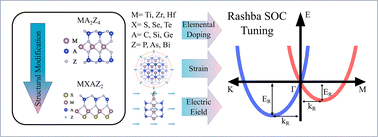
Controllable modulation of Rashba spin–orbit coupling (RSOC) in two-dimensional (2D) quantum systems remains a key challenge in advancing next-generation spintronic devices. Taking MoSi2N4 as a prototype, this study designs a series of 2D semiconductors with significantly enhanced RSOC by strategically incorporating heavy elements and applying structural engineering techniques. Results demonstrate that substituting C and Bi at the A and Z sites in the MoSi2N4 framework efficiently activates substantial RSOC. Further structural modifications to the MXAZ2 system yield even stronger RSOC strength (αR), with values such as 2.09 eV Å in HfTeCAsBi. Detailed characteristic analysis indicates that there is a strong correlation between the work function difference (ΔΦ), the dipole moment (μ) and αR. External field modulation show that biaxial strain, uniaxial strain, and out-of-plane electric fields can dynamically adjust αR through lattice distortion and interfacial charge redistribution. Additionally, the short channel length of HfSeCAsBi-based spin field-effect transistors (s-FETs) provides significant advantages for high-density device integration. This work can offer valuable theoretical insights for band engineering in high-performance spintronic applications.
 Please wait while we load your content...


