


Boosting SERS performance of ZnO via Er3+ doping: enhanced carrier density and charge transfer

Abstract
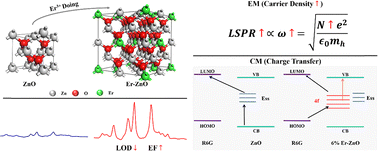
Surface-enhanced Raman scattering (SERS) offers single-molecule sensitivity, but its practical use is constrained by the high cost and instability of noble-metal substrates. Semiconductor based SERS substrates are more stable and scalable, but typically suffer from weak charge transfer due to wide band gaps. Here we report a rare-earth doping strategy to boost the SERS activity of wide-band-gap ZnO. By introducing Er3+ with multielectron 4f orbitals into Zn1−xErxO (x = 0–8 mol%), the carrier density was simultaneously increased and new defect states were created that collaboratively enhance electromagnetic and chemical contributions. The optimized Er3+-doped ZnO substrate enables sensitive and reproducible detection of rhodamine 6G, achieving a detection limit of 2.4 × 10⁻⁸ M, an enhancement factor of 1.73 × 10⁵, and excellent uniformity (RSD = 1.39%). Mott–Schottky analysis confirms carrier density increase upon Er doping, while DFT calculations attribute the dominant contribution to Er d-states and the introduction of 4f-induced surface defect levels that promote charge transfer. This work establishes rare-earth doping as an effective route to engineer semiconductor based SERS substrates and offers a mechanistic framework for designing non-metal SERS systems with synergistic electromagnetic and chemical enhancement.
 Please wait while we load your content...


