


A self-powered WO3-based photoelectrochemical synapse for object distance judgment
 a
Xiang
Qi
*a
a
Xiang
Qi
*a
Abstract
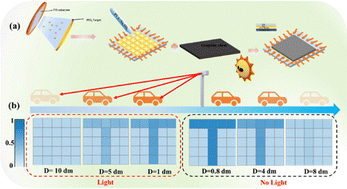
Artificial synaptic devices that emulate biological neural systems hold significant potential for neuromorphic computing and brain-inspired intelligence. The development of low-power, cost-effective synaptic devices is crucial for applications in intelligent recognition and real-time monitoring. In this work, WO3 films were fabricated by radio frequency magnetron sputtering to construct a self-powered WO3-based photoelectrochemical synapse. While the device exhibits self-powered photodetection capabilities at zero bias voltage, its primary function as a synaptic device is demonstrated through the emulation of essential neuroplastic behaviors. The plasticity conversion between the short-term plasticity and long-term plasticity of the photoelectrochemical synapse was achieved by adjusting the number of optical pulses, light power density and frequency. The learning, memory and forgetting behaviors of photoelectrochemical synapses based on WO3 were mapped. More importantly, we further fabricated a 5 × 5 matrix synapse array, successfully simulating the application for object distance judgment. This work highlights the potential of low-energy consumption and low-cost photoelectrochemical synapses, providing a feasible solution for the field of intelligent recognition.
 Please wait while we load your content...


