


The effect of enhanced π–π interactions and tail branching on azobenzene surfactant self-assembly
 a
Jonathan M.
Faber,
a
Ashley P.
Williams,
a
Anna V.
Sokolova,
b
Rico F.
Tabor
*a
and
Kellie L.
Tuck
*a
a
Jonathan M.
Faber,
a
Ashley P.
Williams,
a
Anna V.
Sokolova,
b
Rico F.
Tabor
*a
and
Kellie L.
Tuck
*a
Abstract
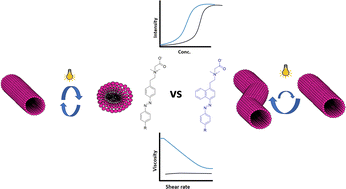
Azobenzene-based surfactants are known for their photo-responsive aggregation behaviour, which is strongly influenced by molecular design. In this work, a series of phenol- and naphthol-derived azobenzene surfactants were synthesised and the influence of π–π interactions, as well as tail branching, on interfacial and self-assembly properties was investigated. trans-Naphthol-derived surfactants formed viscous wormlike micelle (WLM) networks with ellipsoidal cross-section and slow relaxation dynamics, attributed to enhanced π–π stacking in one direction, stabilising the micellar structures. These strong interactions also inhibited photoinduced trans–cis isomerisation under UV light by providing greater micellar stability to the trans-isomeric form. In addition, tail branching further enhanced these effects by enabling a more entangled micellar network. This research provides a deeper understanding of design principles governing photo-responsive surfactant behaviour and offers a strategy for tuning micellar systems for advanced applications.
 Please wait while we load your content...


