


MOF-derived CNFs@Co/C fibers with adjustable cavity size for efficient electromagnetic wave absorption
 *a
Haibo
Yang
*a
*a
Haibo
Yang
*a
Abstract
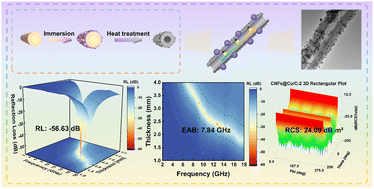
Multi-component design for constructing heterogeneous interfaces has emerged as a key strategy to optimize electromagnetic wave (EMW) absorption. However, precise structural control during heterogeneous interface construction remains a significant challenge. In this study, CNFs@Co/C fibers with tunable cavity size were prepared by coaxial electrospinning and heat treatment. Abundant heterogeneous interfaces between CNFs and metallic Co particles significantly enhance interfacial polarization. The impedance matching of CNFs@Co/C fibers can be effectively tuned by regulating the cavity size. Optimized impedance matching helps more EMWs enter the material and be lost. The results demonstrate that CNFs@Co/C fibers with an appropriate cavity size exhibit outstanding EMW absorption capabilities, attaining a maximum reflection loss of −56.63 dB and an effective absorption bandwidth of 7.84 GHz. Furthermore, the radar stealth performance of the samples was assessed through simulations conducted under far-field conditions. The radar cross section (RCS) value of CNFs@Co/C-2 is less than -10 dB m2 over the entire test range, and the maximum RCS attenuation at θ = 0° could reach 24.09 dB m2. This study provides essential guidance for the development and production of lightweight materials featuring a hollow structure for advanced EMW absorption applications.
 Please wait while we load your content...


