


Charge transfer-induced enhancement of superconductivity and suppression of CDW in Cu-intercalated TaSe2 single crystals

Abstract
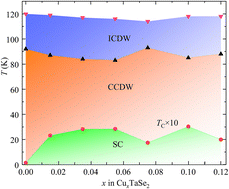
Layered transition metal dichalcogenides (TMDCs) such as TaSe2 provide a compelling platform to study the interplay between charge density wave (CDW) order and superconductivity, two collective electronic states that often compete for the ground state. However, effectively tuning this competition and enhancing superconductivity in such systems remain a significant challenge. Here, we report the successful synthesis of Cu-intercalated TaSe2 single crystals and demonstrate that Cu intercalation leads to a remarkable enhancement of the superconducting transition temperature (TC), increasing from 0.14 K in pristine TaSe2 to a maximum of 3.03 K. Simultaneously, the CDW transition is noticeably suppressed, indicating a strong competition between the two phases. X-ray photoelectron spectroscopy (XPS) and Hall measurements reveal that Cu atoms donate electrons to the TaSe2 layers, increasing the carrier density and thereby driving the observed enhancement of superconductivity. Furthermore, upper critical field (Hc2) measurements exhibit a clear temperature-dependent anisotropy, consistent with an anisotropic superconducting state, while the overall behaviour is well described by a single-gap model. Our work highlights intercalation as an effective strategy to engineer superconducting properties and provides new insights into the intertwined nature of CDW and superconductivity in TMDCs.
 Please wait while we load your content...


