


High-performance X-ray detection based on intrinsic properties of KLu(WO4)2 and KTb(WO4)2 crystals

Abstract
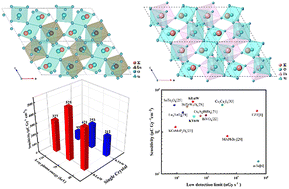
Developing novel high-performance materials to enhance the precision and reliability of X-ray detection technology is critically important for medical diagnosis, industrial non-destructive testing, and scientific research. The monoclinic potassium double tungstates exhibit significant potential in X-ray detection applications due to their high density, strong X-ray attenuation coefficient, and ordered crystal structure. Herein, we selected and grew KLu(WO4)2 and KTb(WO4)2 as novel oxide crystals. Due to the unique one-dimensional infinite chains of WO6 octahedra, which are conducive to efficient transport, these crystals exhibit high mobility lifetime products: 3.1 × 10⁻³ cm2 V−1 for KLu(WO4)2 and 2.59 × 10⁻³ cm2 V−1 for KTb(WO4)2. Additionally, benefiting from a pronounced absorption edge at 70 keV where the probability of photoelectric interaction increases sharply, these crystals achieve high sensitivity under 70 keV photon irradiation (525 µC Gy−1 cm−2 for KLu(WO4)2 and 253 µC Gy−1 cm−2 for KTb(WO4)2). The detectors demonstrated low detection limits (34.8 nGy s−1 for KLu(WO4)2 and 37.6 nGy s−1 for KTb(WO4)2), enabling substantial dose reduction in conventional medical imaging while potentially mitigating associated health risks. These results reveal the application prospects of high-performance X-ray detectors based on KLu(WO4)2 and KTb(WO4)2 crystals in radiation detection.
 Please wait while we load your content...


