


Mechanistic understanding of room temperature phosphorescence in pure organic host–guest systems: efficient emission of molecules lacking n→π* states

Abstract
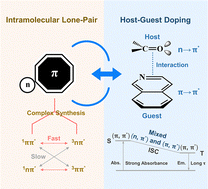
Host–guest doping offers an effective strategy for fabricating and tuning purely organic room temperature phosphorescence (RTP) materials. Herein, four doped materials were prepared employing 8-methoxy-3,6-dimethyl-4-phenyl-1-(piperidin-1-yl)-isoquinoline-7-carbonitrile (IQL) as the guest and different benzophenone derivatives as host matrices to achieve efficient RTP. Three IQL-doped materials exhibit strong dual fluorescence–phosphorescence emission with high phosphorescence quantum yields (≥10.2%) and long lifetimes (≥0.19 s), despite IQL lacking suitable (n, π*) states capable of decaying into the emissive (π, π*) T1 state through an El-Sayed-allowed ISC process. Theoretical studies revealed that doping IQL into a host matrix containing lone-pair electrons enables IQL to “borrow” the (n, π*) state of the host, thereby circumventing the El-Sayed-disallowed ISC process from the (π, π*) guest S1 state to the (π, π*) guest T1 state. Furthermore, the phosphorescence quantum yields of the doped materials vary non-monotonically with the substituent effects of the host molecules, since both electron-withdrawing and strongly electron-donating groups are unfavorable for phosphorescence due to the intricate interplay between the host and guest orbital energy levels. This finding provides a useful protocol for tuning the electronic properties of host–guest materials.
 Please wait while we load your content...


