


Nickel-doped VS4 nanostructures as a promising candidate for nonlinear optical limiter application

Abstract
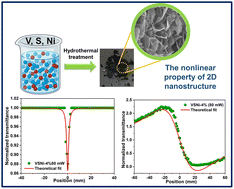
Nonlinear optics plays a pivotal role in modern photonics, supporting a wide range of applications, including frequency conversion and the creation of ultrafast light pulses. Integrating two-dimensional (2D) materials with nonlinear optical systems opens new avenues for exploring the interaction of fundamental excitons, such as electrons, excitons, and photons, within low-dimensional platforms. This synergy holds promise for advancing future photonics and quantum technologies. Ni-doped VS4 with a nanosheet-like structure is prepared using the hydrothermal method. X-ray diffraction (XRD) analysis confirms the monoclinic phase. Raman spectroscopy confirms the different vibrational bands corresponding to vanadium and sulfur. Field-emission scanning electron microscopy (FESEM) images confirm the nanosheet-like structure. Energy-dispersive X-ray spectroscopy confirms the presence of all the elements. X-ray photoelectron spectroscopy (XPS) data confirm the presence of different oxidation states. UV-VIS-NIR spectroscopy data give insights into the band gap of the material. The nonlinear effect is confirmed by the Z-scan approach. The nonlinear absorption coefficient (β) and nonlinear refractive index (n2) are calculated using the open aperture (OA) and closed aperture curves (CA), respectively. The results demonstrate the optical limiting properties of emerging 2D materials. This intensity-dependent nonlinear optical study highlights their immense potential for future photonic and optoelectronic applications.
 Please wait while we load your content...


