


Enhanced photoluminescence quantum efficiency of Cs3Cu2I5 by modulating the superposition of exciton wavefunctions
 e
and
Junghwan
Kim
*bcd
e
and
Junghwan
Kim
*bcd
Abstract
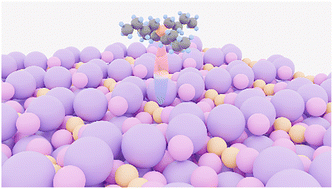
Although Pb-based halide perovskites exhibit excellent performance in light-emitting diode applications, their practical application is limited because Pb is a heavy metal with toxicity and poses serious risks to human health and the environment. Numerous studies have substituted Pb with other elements, such as Sn, Sb, and Bi; however, these materials cannot achieve the desired levels of emission performance and stability. Among them, Cu halide perovskites can potentially address these limitations. Cs3Cu2I5 exhibits an octahedral structure and benefits from a strong Jahn–Teller effect and minimal spatial expansion of the wave function, facilitating effective exciton confinement. In this study, a new strategy to further increase the quantum efficiency and stability of Cu halide perovskites is proposed. After introducing tetrabutylammonium (TBA) into Cs3Cu2I5, the crystal grain size can be modulated, enhancing the photoluminescence quantum yield up to ∼89%. Notably, this value is among the highest reported for Cs3Cu2I5 perovskites. The rearrangement of TBA dopant molecules on the surface of the Cs3Cu2I5 crystals contributes to improved air stability, and scintillator properties under X-ray radiation illumination are demonstrated using TBA-doped Cs3Cu2I5. This study demonstrates that the proposed organic ion introduction strategy on 0D Cs3Cu2I5 scintillation films can improve the luminescence properties.
- This article is part of the themed collection: Journal of Materials Chemistry C HOT Papers
 Please wait while we load your content...


