


 PLATFORM UPDATE:


Picric acid sensing by carbon nanodots: theoretical validation of selectivity

Abstract
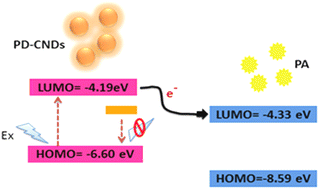
Carbon nanodots (CNDs), known for their exceptional properties, have become a prominent member of the family of nanostructured carbon materials. The most appreciated application of carbon nanodots is sensing, evoked by the reflex response of fluorescence in the presence of specific analytes. Herein we unveil the mechanism of selective sensing of picric acid by carbon nanodots, among a group of analogous compounds. A solid explanation for the selectivity of the system among nitrocompounds is provided through DFT studies. The computed global reactive descriptors describe the relative reactivities of different nitroaromatics and the associated DAM simultaneously classifies them into electron donors and acceptors, from best to worst. Along with these data, a detailed FMO analysis clarifies the selective sensing of picric acid by CNDs, which is in complete agreement with the experimental observations. It is envisioned that this attempt would drive the design of CND-based systems with optimum energy levels, which can serve as promising sensors for analytes of significance.
- This article is part of the themed collections: Quantum Science and Technology and Celebrating International Women’s Day 2026: Women in Journal of Materials Chemistry C
 Please wait while we load your content...


