


Ultralow-threshold UV/solar-pumping waveguide amplifier based on lanthanide-rich metal halide perovskite nanocrystals

Abstract
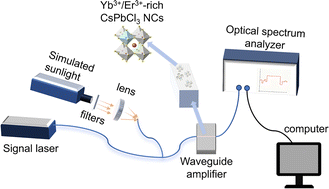
Lanthanide-doped metal halide perovskites (MHPs) generate tunable emissions in visible and near infrared (NIR) with large Stokes shift. One of their most promising emissions is the telecom-band through the luminescence generated by the co-doping of Yb3+ and Er3+. Up to now, high doping concentrations of Yb3+ and Er3+ simultaneously into MHPs nanocrystals (NCs) remained a formidable challenge, which lead to weak luminescence intensity and greatly restrained their practical applications. We have been able to synthesize Yb3+/Er3+-rich CsPbCl3 NCs with bright NIR emission by a modified hot-injection method at higher temperature (280 °C), which overcomes the low-doping barrier in conventional synthetic temperature (220 °C), enhancing the doping level of Yb3+ + Er3+ from typically below 5% to more than 12%. The highly Yb3+/Er3+ doped NCs emitted at 1540 nm efficiently, with an optimal photoluminescence quantum yield (PLQY) of 21.6%. By embedding these highly doped MHPs NCs into a polymer, the stabilities of the NCs in harsh environments can be highly improved. Further, a composite-based on-chip waveguide was fabricated, with a gain at 1540 nm as high as 10.7 dB in just a 1 cm polymer waveguide when the pump power was only 30 mW. In addition, solar pumping of Er3+ has been successfully demonstrated in these waveguides without the use of cumbersome sunlight collectors. Overall, the realization of a 1540 nm polymer on-chip waveguide offers new opportunities for optical microchips, communications, and interconnections.
 Please wait while we load your content...


