


Solution-processed metal oxide synaptic transistor with bilayer Li-ion-conducting gate dielectric
 †a
Roshan Kumar
Singh,
†ab
Subarna
Pramanik,
a
Priyanka
Chetri,
a
Akhilesh Kumar
Yadav,
a
Pijush Kanti
Aich,
a
Pranjit
Barman
c
and
Bhola Nath
Pal
*a
†a
Roshan Kumar
Singh,
†ab
Subarna
Pramanik,
a
Priyanka
Chetri,
a
Akhilesh Kumar
Yadav,
a
Pijush Kanti
Aich,
a
Pranjit
Barman
c
and
Bhola Nath
Pal
*a
Abstract
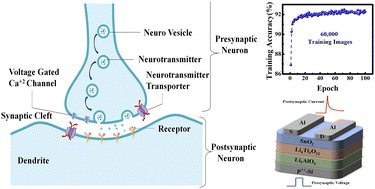
This study presents a cost-effective, solution-processable approach to emulating synaptic plasticity using a solution-processed metal oxide thin-film transistor (TFT) with a bilayer Li-ion-conducting gate dielectric of Li5AlO4 and Li4Ti5O12. This bilayer gate dielectric configuration reduces the DC conductivity of the Li5AlO4 film by three orders of magnitude, effectively reducing the gate leakage current of the transistor by similar orders. Additionally, the fabricated TFT demonstrates an ON/OFF ratio of 7.1 × 10³ with a saturation carrier mobility of 0.62 cm2 V−1 s−1 and a subthreshold swing of 242 mV decade−1. Additionally, this TFT shows high endurance in transfer characteristics over 100 consecutive cycles. Synaptic testing reveals that the device can successfully mimic short-term plasticity by applying various gate signals. Furthermore, paired pulse facilitation (PPF) is observed, fitting well with a double-exponential decay function. The transition from short-term plasticity (STP) to long-term plasticity (LTP) is also demonstrated, alongside potentiation-depression events. These potentiation-depression data are then used for artificial neural network simulations. Using a simple feed-forward neural network, the device achieves a pattern recognition accuracy of 92% with a mean loss of 0.3. A confusion matrix for numbers 0–9 further confirms the high accuracy of the device in recognizing these digits with the highest probability.
 Please wait while we load your content...


