


 PLATFORM UPDATE:


Spin exchange, electronic correlation, and thermoelectric transport in Rb2GeMBr6 (M = V, Mn, Ni) halide double perovskites from first principles calculations

Abstract
Lead-free halide magnetic perovskites have emerged as environmentally benign materials with broad multifunctional potential spanning spintronic, optoelectronic, and thermoelectric domains. Here, we present a comprehensive first-principles investigation of transition-metal-based double perovskites Rb2GeMBr6 (M = V, Mn, Ni) to elucidate their structural, electronic, magnetic, and thermoelectric properties relevant to next-generation multifunctional devices. Structural robustness is confirmed through favorable Goldschmidt tolerance factor values (tdp ≈ 0.95–0.96) and octahedral factor values (µ ≈ 0.36–0.40), while dynamical stability is verified by phonon spectra free of imaginary frequencies. Thermodynamic stability is established through negative formation energies, positive cohesive energies, and favorable positions on the convex hull. Finite-temperature ab initio molecular dynamics simulations at 500 K further verify their structural resilience under thermal perturbation. The electronic structures, computed using both GGA and GGA+mBJ schemes, reveal intrinsic ferromagnetism driven by crystal-field-stabilized high-spin 3d states of the transition-metal ions, yielding magnetic moments of 3µB (V), 5µB (Mn), and 2µB (Ni), respectively. Mean-field estimates predict Curie temperatures in the range of 520–680 K, confirming robust magnetic ordering well above room temperature. Spin-polarized electronic band structures exhibit indirect ferromagnetic semiconducting gaps of 0.8–3.3 eV, with distinct exchange-induced splitting evident at both valence and conduction band edges. Calculated carrier effective masses indicate favorable charge transport, with electrons showing lower effective masses 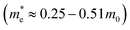 than holes
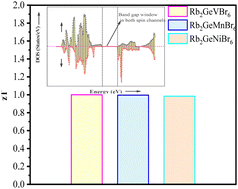
 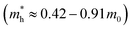 . Thermoelectric analysis reveals large Seebeck coefficients (up to 3000 µV K−1 within optimal chemical potential ranges), ultralow lattice thermal conductivities (<0.7 W m−1 K−1), and high Grüneisen parameters (γ ≈ 2.0–2.5), reflecting strong lattice anharmonicity. These synergistic features yield figures of merit approaching unity across the series. Collectively, Rb2GeMBr6 compounds represent a new class of lead-free, intrinsically ferromagnetic semiconductors with low thermal conductivity and spin-dependent transport characteristics, offering promising prospects for spin-caloritronic, semiconductor spintronic, and thermoelectric energy-conversion technologies.
 Please wait while we load your content...


