


 PLATFORM UPDATE:


Modulating oxidative stress and bacterial infection with carbon dot-infused bioactive hydrogels for infected wound regeneration†
 *b
and
Sasmita
Mohapatra
*ac
*b
and
Sasmita
Mohapatra
*ac
Abstract
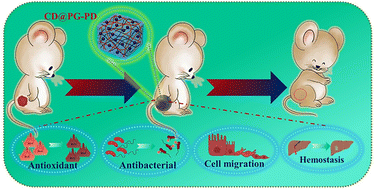
Chronic non-healing wounds arise from sustained oxidative stress due to excessive reactive oxygen species (ROS) accumulation, coupled with persistent bacterial colonization. However, existing wound dressings exhibit limited capability to concurrently mitigate oxidative stress and exert antibacterial activity, thereby impeding wound repair in the adverse wound microenvironment. Herein, we designed a multifunctional hydrogel dressing by integrating biomass-derived carbon dots (CD) into a polyvinyl alcohol (PVA), gelatin, and dopamine-based polymeric gel matrix (CD@PG-PD), thereby endowing it with inherent antibacterial and antioxidant properties. The multifunctional CD@PG-PD hydrogel exhibited high mechanical strength, elevated swelling properties, and self-healing behaviour, along with pH-dependent degradation. The CD@PG-PD hydrogel exhibited pronounced antibacterial activity against Gram-positive Staphylococcus aureus (S. aureus) and Gram-negative Escherichia coli (E. coli) bacteria, which are the primary causes of the majority of wound infections. The CD@PG-PD hydrogel lowered bacterial survival rates to 5% and 8% for E. coli and S. aureus, respectively. Moreover, CD@PG-PD demonstrated excellent biocompatibility while significantly enhancing cell migration to the scratch area, almost closing the gap. More importantly, the CD@PG-PD hydrogel successfully closed 92% of the wound area in the in vivo S. aureus-infected skin wound model, while exhibiting great hemostatic performance. As a result, this integrated strategy has significant potential for improving the healing of chronic wounds.
- This article is part of the themed collection: Foundations to frontiers in materials chemistry: 75 years of IIT Kharagpur
 Please wait while we load your content...


