


A thiol–ene click chemistry-mediated space-maintaining Janus collagen membrane for GBR with antibacterial, immunomodulatory, and proangiogenic functions
 abcd
abcd
Abstract
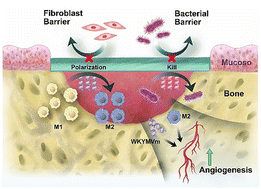
Resorbable collagen membranes are widely used for guided bone regeneration (GBR) but suffer from premature degradation, inadequate space maintenance, and poor infection and osteoimmune regulation in a bacteria-rich oral environment. Herein, we developed a hydrophobic, antibacterial, anti-inflammatory Janus membrane (HAA-JM) on a clinical collagen platform, directionally engineering soft-tissue and bone-facing sides. Via silane coupling and thiol–ene click chemistry, the outer surface was grafted with perfluoroalkyl groups, enhancing wet mechanical strength and anti-collapse performance and slowing enzymatic degradation. The hydrophilic inner surface retains porous collagen architecture, functionalized with antibacterial peptide IK8 and immunomodulatory peptide WKYMVm. The HAA-JM exhibits excellent cytocompatibility and hemocompatibility and potent antibacterial/anti-biofilm activity against Escherichia coli (E. coli) and methicillin-resistant Staphylococcus aureus (MRSA), promotes M1-to-M2 macrophage polarization, and supports endothelial tube formation. In MRSA-challenged rat premaxillary defects, the HAA-JM mitigates infection and membrane complications, maintains in situ stability, and significantly improves the bone volume fraction and mineral density versus conventional collagen membranes. Subcutaneous implantation confirms prolonged in vivo presence with favourable tissue/systemic responses. This Janus amphiphilic membrane integrates extended space maintenance, infection control, and osteoimmune modulation, offering a promising solution to overcome the limitations of current resorbable GBR membranes in infection-prone oral environments.
 Please wait while we load your content...


