


 PLATFORM UPDATE:


Fe-MOF-based fluorescent and colorimetric dual-readout nanoprobe for the sensitive detection of α-lipomycin

Abstract
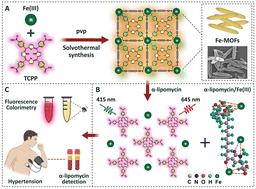
Salt-sensitive hypertension represents a significant global health burden, yet its underlying pathogenic mechanisms remain incompletely understood. Recent evidence indicates that the microbial metabolite α-lipomycin contributes to vascular dysfunction by selectively suppressing the endothelial TRPV4 channels, thereby impairing vasodilation and promoting the development of salt-sensitive hypertension. Consequently, the highly sensitive and selective detection of α-lipomycin is of critical importance for early risk assessment and intervention. Herein, Fe-MOF nanorods were prepared using TCPP as the organic ligand and Fe(III) as the metal center via a solvothermal method and used for α-lipomycin detection. Specific host–guest effects between α-lipomycin and the Fe(III) centers in Fe-MOFs selectively disrupt the ligand-to-metal charge transfer within Fe-MOFs, triggering simultaneous fluorescence emission at 645 nm and a brown chromogenic appearance. Consequently, Fe-MOF nanorods serve as a fluorescent and colorimetric nanoprobe for the dual-mode detection of α-lipomycin. The sensor demonstrated a broad linear response range of 0.05–10 µM and ultralow detection limits of 23.83 nM (fluorescence) and 409.80 nM (colorimetry). Furthermore, the dual-signal response of the Fe-MOF nanoprobe toward α-lipomycin further confers exceptional selectivity against interferents and high repeatability (RSD < 5.64%). Notably, practical validation using tap water shows acceptable recovery rates of 93.47% to 109.35%. Importantly, clinical serum analyses demonstrate elevated α-lipomycin levels in hypertensive patients, validating the strong practicability of the Fe-MOF nanoprobe for early pathogenesis detection and therapeutic monitoring. These findings highlight the Fe-MOF nanoprobe as a dual-mode optical platform for the selective and reliable α-lipomycin detection. Its field-deployable design overcomes the clinical limitations in the utility of conventional methods, such as mass spectrometry. It also offers a promising approach for applications in pathogenesis research, typing, early warning, and prevention of salt-sensitive hypertension.
 Please wait while we load your content...


