


Polymeric quaternary ammonium enabled contact-active, bulk-stable and biocompatible antibacterial catheters without leaching-dependent antimicrobial additives

Abstract
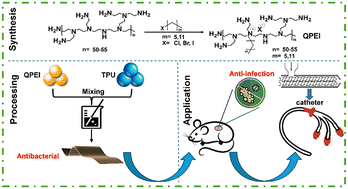
Catheter-associated infections remain a major clinical challenge due to microbial colonization on medical plastics. Conventional strategies using small-molecule antibacterial additives or surface coatings often suffer from rapid leaching, limited durability, and reduced stability under sterilization and mechanical stress. In this work, we designed a polymeric quaternary ammonium antibacterial agent, quaternized polyethyleneimine (QPEI), for bulk incorporation into the thermoplastic polyurethane (TPU). QPEI exhibits strong cationic contact-killing activity, low diffusivity, high thermal stability (>200 °C), and negligible cytotoxicity, enabling non-leaching, long-term antibacterial performance. QPEI–TPU composites showed homogeneous dispersion, as confirmed by AFM, and exhibited >99% bactericidal activity against S. aureus and E. coli, with zone-of-bactericidal tests confirming minimal leaching. Their antibacterial activity remained after repeated autoclaving, ethylene oxide treatment, and UV and γ-irradiation sterilization methods. Catheters fabricated via standard extrusion retained mechanical properties comparable to those of commercial TPU, exhibited broad-spectrum antibacterial activity, and demonstrated low hemolysis and high cell viability. The results of animal experiments demonstrated the in vivo anti-infection performance of the produced antibacterial QPEI–TPU catheters. The current work is expected to provide a facile and feasible strategy for the development and application of non-leaching and long-term antibacterial catheters.
- This article is part of the themed collection: Journal of Materials Chemistry B HOT Papers
 Please wait while we load your content...


