


Antimicrobial cotton fabrics modified with a cationic perylene diimide derivative for durable and superior sterilization
 *a
*a
Abstract
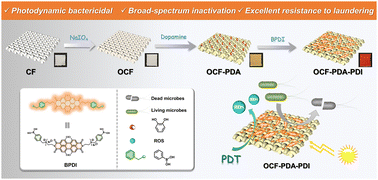
High biocidal efficacy, excellent durability and great biocompatibility are essential for the practical utility of antimicrobial fabrics in complex environments such as hospitals and wild environment. Herein, a novel cationic perylene diimide derivative (BPDI) with enhanced solubility and high reactive oxygen species (ROS) yield was designed and synthesized. This photosensitizer is covalently linked onto cotton fabrics to construct OCF-PDA (polydopamine)-PDI featuring high-density quaternary ammonium salt (QAS) groups. The functionalized fabric OCF-PDA-PDI exhibits excellent antimicrobial capability through a dual-mechanism antimicrobial strategy: (1) sunlight-driven photodynamic therapy (PDT) via ROS generation and (2) contact sterilization through membrane-disruptive QAS groups. As a result, OCF-PDA-PDI exhibits excellent antimicrobial activities against Escherichia coli (E. coli, Gram-negative bacteria) and Staphylococcus aureus (S. aureus, Gram-positive bacteria) under the synergistic effect of the physical antimicrobial action of QAS groups and the photodynamic antimicrobial action generated by light excitation. Crucially, OCF-PDA-PDI maintains >97% antimicrobial efficiency against E. coli and near-complete eradication (>99.9%) of S. aureus and C. albicans (Candida albicans, fungi) after 50 laundering cycles, significantly exceeding FZ/T 73023-2006 AAA-grade standards. Therefore, owing to its great biocompatibility, OCF-PDA-PDI holds strong potential for applications in both clinical settings and everyday use.
 Please wait while we load your content...


