


Enhancing the anticancer efficacy of a nitric oxide and formaldehyde co-donor through isotope substitution
 *a
*a
Abstract
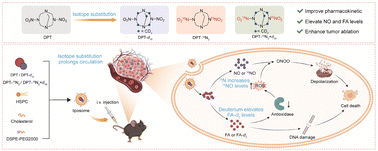
Rapid systemic elimination of drugs remains a significant challenge in cancer therapy. Herein, an isotope substitution strategy is employed to enhance the therapeutic potential of a novel nitric oxide and formaldehyde co-donor, 3,5-dinitro-1,3,5,7-tetraaza[3.3.1] nonane (DPT), by modulating its metabolic fate and improving its pharmacokinetic behavior. Based on the parent compound, deuterated (DPT-d10), nitro-15N-substituted (DPT-15N2), and dual-modified (DPT-15N2 + d10) derivatives were synthesized. These isotope substitution derivatives retain the electronic properties and functional integrity of the original molecule while slowing the metabolic rate of both the parent compound and its active components (formaldehyde and nitric oxide), which prolongs in vivo residence time, leading to enhanced tumor growth inhibition with minimal adverse effects. Notably, benefiting from the synergistic isotope effects of deuteration and nitro-15N substitution, DPT-15N2 + d10 exhibits superior antitumor activity. Therefore, this study establishes a paradigm for overcoming the limitation of rapid systemic clearance in anticancer drug development.
 Please wait while we load your content...


