


 PLATFORM UPDATE:


Unveiling the mechanism of redox ions for enhanced continuous discharge and output power in ionic thermoelectric materials
 a
Jing
Jiang
*a
a
Jing
Jiang
*a
Abstract
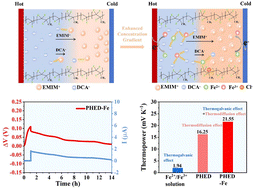
Ionic thermoelectric materials have attracted significant attention due to their high thermopower and flexibility. However, their working mechanism, relying on electric double-layer capacitive effects, causes intermittent discharge behavior, severely restricting their practical applications. Although the introduction of redox couples enables continuous discharge, existing studies have simplistically attributed the resulting enhancement in thermoelectric performance to a macroscopic “synergistic superposition effect”, failing to deeply uncover the intrinsic microscopic modulation mechanism of redox ions toward ionic diffusion behavior under temperature gradients. To address this issue, we employ Fe2+/Fe3+-doped PVDF-HFP/[EMIM][DCA] ionogels (PHED-Fe) as a primary model system, combined with molecular dynamics simulations and experimental validation across various redox systems, to systematically investigate the underlying microscopic mechanism. The results indicate that redox ions not only endow the material with stable continuous discharge capability but also weaken the Coulomb interactions between host ions and selectively inhibit the diffusion of DCA−, thereby enlarging the concentration gradient between cations and anions across the cold and hot ends and significantly enhancing thermopower and output power. Based on these results, an integrated thermoelectric device was further constructed and, through human body heat harvesting experiments, demonstrated its practical application potential in low-grade waste heat recovery.
 Please wait while we load your content...


