


 PLATFORM UPDATE:


Carbon vs. carbon: rational host selection for Zn–I2 cathodes

Abstract
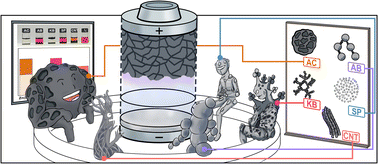
Aqueous Zn–I2 batteries are limited by the formation and migration of soluble polyiodides, making carbon important not only as a conductive framework, but also as the host that defines the local iodine-conversion environment. Here, five representative carbons, namely activated carbon (AC), acetylene black (AB), Ketjen black (KB), Super C65 (SP), and carbon nanotubes (CNTs), were systematically compared under unified conditions. Host performance was not governed by conductivity alone, but depended on polyiodide confinement and charge transport balance. AC provided the strongest confinement-oriented host environment and the highest overall performance, whereas I2-source free controls showed that it also contributed the largest host background, requiring deconvolution before performance evaluation. By contrast, AB/SP showed weak standalone host behavior but low host background, making them suitable control carbons. I2 amount/supply mode further influenced the response through both iodine inventory and host accessibility. Extending the voltage window further revealed an additional high-potential capacity contribution, which was conservatively assigned as non-reversible pseudo 4e− behavior. Accordingly, carbon selection should be guided by function rather than conductivity alone, balancing performance, host background, and intended applications. Overall, this work provides a practical framework for rational host selection and cathode design in Zn–I2 batteries.
- This article is part of the themed collections: Journal of Materials Chemistry A HOT Papers and Journal of Materials Chemistry A Emerging Investigators 2026
 Please wait while we load your content...


