


 PLATFORM UPDATE:

Rapid and high-precision photoinduced 3D printing enabled by thioacetal mediated cationic degenerate chain transfer polymerization

Abstract
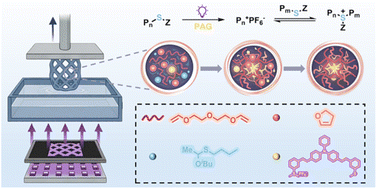
Cationic photopolymerization offers inherent advantages for additive manufacturing, including oxygen tolerance and dark-curing capability, yet its practical implementation in high-resolution 3D printing remains limited by the lack of molecular-level control. Herein, we report a photoacid generator (PAG)-induced cationic degenerate chain transfer polymerization of vinyl ethers mediated by thioacetals under visible light (405 nm). The system exhibits rapid polymerization kinetics, tunable molecular weights (Mn = 3100–33700), narrow molecular-weight distributions (Đ = 1.30–1.67), and clear controlled characteristics, as evidenced by pseudofirst-order kinetics and successful chain extension. Integration of this chemistry into digital light processing (DLP) 3D printing via incorporation of a divinyl ether crosslinker affords photocurable resins capable of high-resolution fabrication with excellent dimensional and structural fidelity. Systematic modulation of resin composition enables precise tuning of mechanical properties, yielding materials spanning brittle, tough, and elastomeric regimes. This work establishes a versatile and operationally simple controlled cationic photopolymerization strategy for advanced additive manufacturing and expands the toolbox for designing functional polymer networks with programmable properties.
- This article is part of the themed collection: Journal of Materials Chemistry A Emerging Investigators 2026
 Please wait while we load your content...


