


 PLATFORM UPDATE:


Reversible luminescence detection of dihalogenomethanes in a 3D CuI coordination polymer assembled by a thioether-functionalized POSS ligand

Abstract
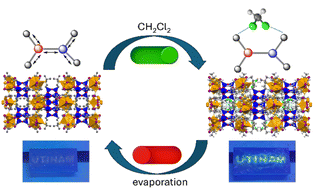
Halogenated volatile organic compounds (VOCs) are classified as highly hazardous chemicals due to their toxicity, carcinogenicity, and contribution to global warming. The development of real-time, in situ visual devices for their detection remains a significant challenge. Herein, we report the facile synthesis of a hybrid 3D-coordination polymer (CP) exhibiting metal–organic framework (MOF)-like properties and luminescence turn-on/turn-off behaviour upon exposure to dihalomethane vapours. This material is obtained via the self-assembly of a thioether-functionalized polyhedral oligomeric silsesquioxane (POSS) with copper iodide at room temperature. Structurally, it consists of dissymmetric Cu4(µ3-I)4 cubane clusters acting as secondary building units (SBUs), characterized by partially exceptional long Cu–Cu distances. This porous material features one-dimensional channels with a pore-limiting diameter that selectively allows the uptake of small molecules such as dichloromethane and dibromomethane. Upon adsorption of these guest molecules, a rapid luminescence turn-on is observed. In-depth crystallographic analyses at variable temperature in the range from 100 to 300 K reveal formation of weak hydrogen-bonding interactions between the CP framework and the guest molecules. The enhanced emission is therefore attributed to the suppression of non-radiative decay due to restricted vibrational/rotational motions upon guest confinement. The weak nature of these interactions ensures the reversibility of the process. Moreover, the crystalline structure of the material is preserved during adsorption–desorption cycles, resulting in an excellent recyclability.
- This article is part of the themed collection: Celebrating the 80th birthday of Professor Dr Ulrich Schubert
 Please wait while we load your content...


