


 PLATFORM UPDATE:


Dual-stabilization strategy enabled high-entropy sulfide@carbon spheres for high-performance sodium storage

Abstract
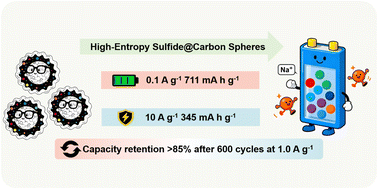
Despite their promise for grid-scale energy storage, sodium-ion batteries (SIBs) are hindered by the lack of robust anodes capable of tolerating severe volume changes during alloying-based sodiation. Herein, we present a rationally designed core–shell composite, (FeCoNiCuMo)S2/C, which integrates high-entropy lattice stabilization with architectural confinement to address both atomic- and mesoscale structural challenges. The high-entropy sulfide (HES) core provides intrinsic lattice robustness through multi-element distortion, while the continuous spherical carbon shell serves as a dynamic scaffold to buffer volumetric expansion and maintain interfacial integrity. This dual-stabilization design effectively decouples electrochemical reactions from mechanical strain, promoting a stable electrode–electrolyte interface and a mechanically resilient solid electrolyte interphase (SEI). As a result, the (FeCoNiCuMo)S2/C anode delivers a high reversible capacity of 345 mAh g−1 at an ultrahigh current density of 10 A g−1 and retains 85% of its capacity over 600 cycles. This work establishes a generalizable design principle for SIB anodes by integrating entropy-stabilized active materials with conformal carbon architectures to simultaneously enhance bulk framework durability, interfacial stability, and high-rate performance.
 Please wait while we load your content...


