


 PLATFORM UPDATE:


Regulating molecular packing and crystallization kinetics via trifluoromethyl-functionalized solid additives for efficient organic solar cells
 *a
*a
Abstract
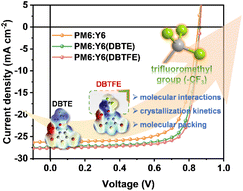
Precise control over crystallization kinetics and molecular packing is crucial for achieving high-efficiency organic solar cells (OSCs), yet balancing controllable morphology evolution with process compatibility remains a key challenge. Here, we develop a trifluoromethyl-functionalized volatile solid additive (DBTFE) based on an ester-substituted thiophene unit to regulate active-layer morphology. Compared with its non-fluorinated counterpart DBTE, DBTFE exhibits a stronger interaction with the acceptor Y6, promoting tighter π–π stacking and more ordered molecular packing, as revealed by theoretical calculations. During film formation, DBTFE prolongs crystallization and optimizes the vertical phase distribution, resulting in a more interpenetrating morphology and enhanced crystallinity. Consequently, the DBTFE-treated PM6:Y6 device achieves a power conversion efficiency (PCE) of 18.6%, accompanied by suppressed trap-assisted and bimolecular recombination, improved exciton dissociation, and more balanced charge transport. Notably, this additive strategy demonstrates excellent universality across multiple systems, including PM6:L8-BO, PM6:BTP-eC9, and D18:L8-BO, all exhibiting improved efficiencies, with a peak PCE of 20.1% achieved in the D18:L8-BO system. This work provides an effective strategy for regulating crystallization behavior and morphology via trifluoromethyl-functionalized volatile solid additives, offering a generalizable pathway toward high-performance OSCs.
- This article is part of the themed collection: Journal of Materials Chemistry A Emerging Investigators 2026
 Please wait while we load your content...


