


 PLATFORM UPDATE:


In-cell electropolymerization of 10-(N-pyrrolyl)phenoxazine into a phenoxazine-grafted polypyrrole cathode for high-voltage and ultrastable Li-ion batteries
 b
and
Ya
Du
*a
b
and
Ya
Du
*a
Abstract
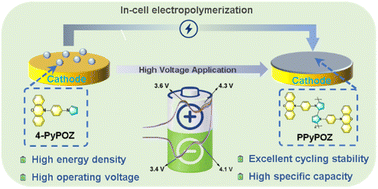
Organic electrode materials face critical challenges of dissolution in electrolytes and limited operating voltage, which hinder their practical application. To overcome these barriers, we designed a novel electropolymerizable molecule, phenoxazine-functionalized polypyrrole (PPyPOZ), as a high-voltage cathode. Through a one-step in-cell electropolymerization process that concurrently activates the electrode, the monomer is directly transformed into a stable, π-conjugated polymer framework on the current collector. This approach fundamentally inhibits dissolution and establishes an intrinsic conductive pathway. The resulting PPyPOZ cathode exhibits a high discharge plateau (∼3.6 V) and a specific capacity of 174 mAh g−1, yielding an impressive energy density of 626.4 Wh kg−1, which ranks among the highest for organic cathodes. It also demonstrates excellent rate capability and outstanding cycling stability, retaining 95% capacity after 1170 cycles at 3 A g−1 and achieving a capacity retention of nearly 100% over 1200 cycles at 0.2 A g−1. Furthermore, the cathode delivers stable performance under practical conditions, including high mass loading (>2 mg cm−2) and sub-zero temperature (−7 °C), demonstrating its potential for real-world applications. The charge storage mechanism, identified as a dominant capacitive process with reversible PF6− doping/dedoping at the phenoxazine sites, was elucidated via comprehensive electrochemical analysis, DFT simulations, and ex situ characterization. This work validates the strategy of integrating redox-active units into conjugated polymers via in situ electropolymerization, paving the way for high-energy, durable organic batteries.
 Please wait while we load your content...


