


 PLATFORM UPDATE:


Preparation of polyaniline/polyurethane hydrogels for high-performance all-in-one supercapacitors with remarkable pressure-resistance
 ab
Pengfei
Huo
*ab
ab
Pengfei
Huo
*ab
Abstract
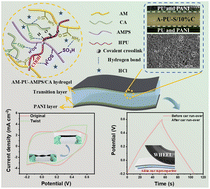
The stability of the electrode–electrolyte interface is an important factor affecting the performance of flexible supercapacitors. In this study, a novel double network composite hydrogel with high pressure resistance is synthesized by using double bond-terminated polyurethane (HPU) as a cross-linker, 2-acrylamido-2-methylpropanesulfonic acid (AMPS) and acrylamide (AM) as crosslinking monomers, and cellulose acetate (CA) as an additive. By in situ polymerization of polyaniline (PANI) on the composite hydrogel, a PANI/A-PU-S/C-based conductive polymer hydrogel (CPH) with a highly integrated structure is synthesized. Due to the synergistic effect of covalent and hydrogen bonds the obtained CPH exhibits excellent flexibility and compression resistance which is conducive to the fabrication of compression resistant all-in-one supercapacitors by directly clamping the CPH between two carbon cloths. Among all samples, the PANI/3A-PU-S/C-based all-in-one supercapacitor delivered the highest areal specific capacitance of 849.92 mF cm—2 and a maximum energy density of 73.38 µW h cm−2, which remained at 53.13 µW h cm−2 at a power density of 3379 µW cm−2, as well as outstanding cyclic stability with a capacitance retention of 85.5% after 8000 charge–discharge cycles. Benefiting from the excellent performance of the CPH and the all-in-one structure, the all-in-one supercapacitor can still maintain remarkable electrochemical performance under bending and compression deformation. Due to the tight integration of the electrode–electrolyte interface, the supercapacitor maintains a complete structure and normal energy output even after repeated running-over by a car.
 Please wait while we load your content...


