


 PLATFORM UPDATE:

Robust interpenetrating network type amphoteric ion exchange membranes for high performance vanadium redox flow batteries

Abstract
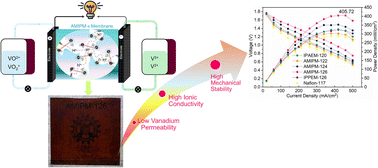
Fluorine-free, robust polyethylene-poly-p-methylstyrene interpenetrated network-based crosslinked amphoteric polyelectrolyte separators have been architected for all vanadium redox flow battery (VRFB) applications. This engineering strategy incorporates both sulfonic (–SO3−) and ammonium (NR3+) moieties into the polymer electrolyte, enhancing proton selectivity and overcoming the trade-off between conductivity and vanadium permeability. The fabricated amphoteric interpenetrating type ion exchange membranes (AMIPM-x) demonstrated exceptional chemical, thermal, and mechanical stability while preserving their desirable physico-/electrochemical properties. Among the series, AMIPM-126 exhibits the optimal combination of high IEC (–NR3+: 1.30; –SO3H: 1.39 meq g−1), high ionic conductivity (11.68 × 10⁻² S cm−1), and very low VO2+ permeability (1.20 × 10⁻⁷ cm2 min−1), resulting in enhanced ionic selectivity (9.73 × 10⁵ S min cm−3) far superior to the Nafion-117 membrane. The membrane exhibits good chemical, oxidative, thermal and mechanical strength, which is a result of inherent acid–base ionic interactions. The AMIPM-126 membrane in a VRFB single cell exhibits good electrochemical properties with CE = 99.02%, VE = 78.80%, EE = 78% at 130 mA cm−2 and the maximum power density (405.72 mW cm−2) among the examined membranes. These findings indicate that the designed amphoteric interpenetrating membranes may be a promising alternative to PFSA based membranes in terms of low cost which can be scaled up to the industrial level and emerge as a solid contender for next-generation long-life VRFBs.
 Please wait while we load your content...


