


 PLATFORM UPDATE:


A synergistic approach combining Cu doping and a CuO/C intertwined network for the Na4Fe3(PO4)2P2O7 cathode: enhancing high-rate performance and structural robustness
 a
and
Jinli
Zhang
*a
a
and
Jinli
Zhang
*a
Abstract
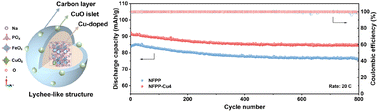
Na4Fe3(PO4)2P2O7 (NFPP) has emerged as a highly promising cathode material for sodium-ion batteries owing to its high theoretical capacity and stable three-dimensional framework structure. However, its poor intrinsic electronic conductivity, challenges in phase purity, and the inherent structural defects of conventional carbon coatings severely hinder charge transfer kinetics, leading to unsatisfactory rate capability and cycling stability. In this work, we propose and implement a novel copper-based synergistic modification strategy that simultaneously incorporates Cu-bulk doping and a CuO/C interfacial layer into NFPP. Among the synthesized lychee-like structured cathode materials, the optimal NFPP-Cu4 cathode delivers a high initial discharge capacity of 115.0 mA h g−1 at 0.1C, a reversible capacity of 92.3 mA h g−1 at 20C, and 88.5% capacity retention after 2000 cycles. When assembled into full cells, the material shows superior cycling stability, achieving 89.5 mA h g−1 at 5C with 92.7% capacity retention after 500 cycles. Through characterization by XRD, HRTEM, XPS, UV-vis, etc., it is revealed that NFPP-Cu4 forms a multi-component composite system through Cu doping and a CuO/C composite coating, which can effectively suppress the formation of the inactive NFP impurity phase. This study presents a multidimensional synergistic modification approach via a single metallic element, offering a new and effective strategy for the development of high-performance polyanionic cathode materials for SIBs.
 Please wait while we load your content...


