


 PLATFORM UPDATE:


A-site high-entropy engineering enables a cobalt-free perovskite air electrode with exceptional activity and durability for reversible solid oxide cells
 a
and
Yifeng
Zheng
*a
a
and
Yifeng
Zheng
*a
Abstract
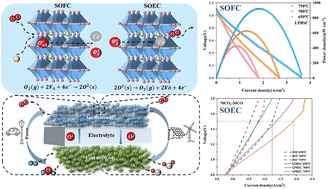
The limited catalytic activity and durability of cobalt-free perovskite air electrodes present a significant obstacle to their widespread application in reversible solid oxide cells (RSOCs). The cobalt-free Bi0.5Sr0.5FeO3−δ (BSF) air electrode exhibits competitive electrochemical performance and is expected to be further optimized. Herein, we report the design of an A-site high-entropy perovskite oxide, La0.2Pr0.2Bi0.2Sr0.2Ca0.2FeO3−δ (LPBSC), through the introduction of small-sized atoms at the A-site of BSF to induce lattice distortion. The optimized LPBSC demonstrates exceptional oxygen-ion diffusivity (Dchem = 2.529 × 10⁻⁴ cm2 s−1) and surface exchange kinetics (Kchem = 5.25 × 10⁻⁴ cm s−1), leading to a 54.24% reduction in polarization resistance (from 0.148 to 0.059 Ω cm2) at 750 °C. Moreover, LPBSC exhibits excellent tolerance to CO2 and Cr poisoning, with its polarization resistance remaining unchanged even under 10% CO2 or intensified Cr poisoning conditions. In the fuel cell mode, the single cell achieves a remarkable peak power density of 921 mW cm−2 at 750 °C. In the electrolysis cell mode, a current density of 1915 mA cm−2 is achieved at 750 °C under an applied voltage of 1.5 V in a 70% CO2/30% CO atmosphere. The A-site high-entropy strategy induces lattice distortion in BSF, enhancing the structural stability and suppressing the phase transformation and elemental segregation, thereby preserving outstanding catalytic activity. This design significantly improves resistance to both CO2 and Cr poisoning, offering a novel approach to enhancing the oxygen reduction/evolution reaction (ORR/OER) activity and environmental tolerance of cobalt-free air electrodes for RSOCs.
 Please wait while we load your content...


