


 PLATFORM UPDATE:


Synergistic promotion of oxygen reduction electrocatalysis by chlorine incorporation in biomass-derived S/N co-doped carbon
 *a
*a
Abstract
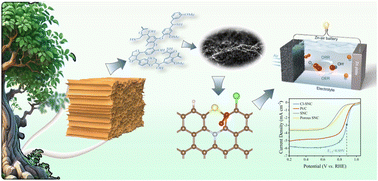
Although heteroatom-doped carbon materials have been extensively developed as oxygen reduction reaction (ORR) electrocatalysts, the role of halogen doping in facilitating the activity of these metal-free catalysts still remains insufficiently elucidated. Herein, we propose a chlorine-incorporation strategy to fine-tune the electronic structure of carbon active sites and enhance the ORR performance of S/N co-doped carbon materials (denoted as Cl-SNC). Using sodium chloride as the Cl source, a chlorine-containing porous carbon framework has been well-constructed from sulfate lignin. Experimental and theoretical analyses indicate that the introduction of Cl optimizes the charge distribution at neighboring carbon sites, thereby facilitating O2 adsorption. Benefiting from this design, the resulting Cl-SNC electrocatalyst demonstrates outstanding ORR activity with a half-wave potential (E1/2) of 0.89 V, outperforming Pt/C and most reported non-precious-metal catalysts. When integrated into an aqueous zinc–air battery, it delivers a peak power density of 160 mW cm−2 and an excellent specific capacity of 1179.2 mAh g−1. This work not only provides a green, low-cost route for the synthesis of high-performance metal-free ORR catalysts, but also offers new perspectives on air-cathode design for zinc–air batteries.
 Please wait while we load your content...


