


 PLATFORM UPDATE:


Enhancing high-temperature capacitive energy storage performance of BOPP films via constructing a dual-barrier structure

Abstract
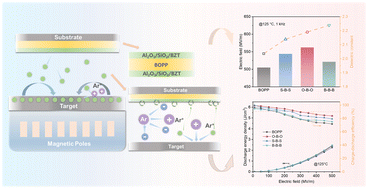
As a key dielectric material for commercial film capacitors, biaxially oriented polypropylene (BOPP) exhibits severe degradation in energy storage properties under high-temperature conditions, limiting its further application. Experimental verification confirms that carrier injection induced by the reduction in barrier height at the electrode/dielectric interface under high temperatures is the dominant mechanism responsible for the surge in losses. To suppress electrode-limited conduction, this study proposes an environmentally friendly surface modification strategy based on magnetron sputtering technology. This involves constructing an inorganic nano barrier layer on the BOPP substrate surface to form a dual-barrier structure comprising “electrode–inorganic layer-dielectric”. At the same time, the surface morphology of composite films is crucial to their dielectric strength. By optimizing the sputtering process, a uniform, continuous, and dense Al2O3 interface layer (roughness ∼10 nm) is obtained. Its wide bandgap and moderate relative permittivity significantly suppress Schottky injection and hinder carrier transition. The results indicate that the Al2O3/BOPP/Al2O3 composite film achieved a discharge energy density of 2.42 J cm−3 at 125 °C, outperforming both the SiO2/BOPP/SiO2 system (wide bandgap ∼9.0 eV) and the BZT/BOPP/BZT system (high εr). This result demonstrates that the synergistic optimization of the interface layer bandgap, dielectric constant, and surface roughness is crucial for suppressing high-temperature carrier injection. Overall, this interfacial engineering strategy demonstrates excellent versatility, providing a viable pathway for constructing polymer-based capacitors that simultaneously achieve high dielectric strength and high energy storage density.
- This article is part of the themed collection: Journal of Materials Chemistry A HOT Papers
 Please wait while we load your content...


