


Tailoring Re-loaded core–shell Ni structures embedded in mesoporous silica for the selective transformation of levulinic acid into γ-valerolactone
 †a
Chularat
Sakdaronnarong,
a
Suttichai
Assabumrungrat,
de
Kittisak
Choojun,
f
Tawan
Sooknoi,
e
Keiichi
Tomishige
g
and
Atthapon
Srifa
*a
†a
Chularat
Sakdaronnarong,
a
Suttichai
Assabumrungrat,
de
Kittisak
Choojun,
f
Tawan
Sooknoi,
e
Keiichi
Tomishige
g
and
Atthapon
Srifa
*a
Abstract
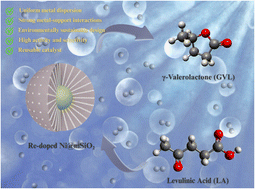
Heterogeneous core–shell catalysts have attracted significant interest because they integrate multiple catalytic functions within a single, precisely engineered architecture. In this work, we report the rational synthesis and catalytic evaluation of a Re-loaded Ni core–shell catalyst embedded in mesoporous silica for the efficient hydrogenation of levulinic acid (LA) to γ-valerolactone (GVL). The core–shell configuration enables effective confinement of Ni nanoparticles within the porous silica matrix and stabilizes spatially separated Ni and ReOX species with complementary catalytic functions. Comprehensive physicochemical characterization confirmed the successful formation of the core–shell structure, its high structural stability, and the presence of confined metallic Ni sites responsible for H2 activation and oxophilic ReOX-derived acid sites for oxygenate activation. Under optimized conditions, the Ni12Re1.63-CS catalyst achieved complete LA conversion with a GVL yield exceeding 94% within 2 h, outperforming non-core-shell catalysts. The catalyst also displayed high intrinsic activity, with a turnover frequency of up to ∼36 h−1, and retained an excellent GVL selectivity of approximately 80% during recycling, despite a gradual decrease in LA conversion. These findings demonstrate that spatial separation of hydrogenation and oxophilic adsorption sites within a core–shell architecture is critical for enhancing activity and selectivity in biomass-derived platform molecule upgrading.
- This article is part of the themed collection: Journal of Materials Chemistry A HOT Papers
 Please wait while we load your content...


