


Au-decorated hollow CuO with modulated electronic structure for efficient electrocatalytic glucose oxidation
 *a
*a
Abstract
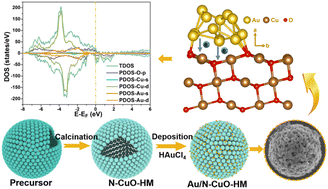
Transition metal oxides (TMOs) are promising electrocatalysts for non-enzymatic glucose (NEG) sensors; nevertheless, their electrocatalytic performance is impeded by sluggish electron transfer kinetics and inadequate reactant adsorption. The rational design of the electronic and geometric structures of TMOs is crucial for enhancing their electrocatalytic activity toward glucose oxidation. Here, an Au-decorated hollow microspherical N-doped CuO heterojunction (Au/N-CuO-HM) was successfully prepared by a solvothermal method followed by calcination. Density functional theory (DFT) calculations and experimental results indicate that the formation of the Au/CuO heterojunction creates a built-in electric field at the interface, promoting electron transfer and reducing charge transfer resistance. More importantly, the incorporation of Au results in an upward shift of the d-band center (εd) for the Cu sites, thereby strengthening the interaction between the electrocatalyst and glucose, as confirmed by the more negative adsorption energy of glucose after Au decoration (−2.351 vs. −1.856 eV). Simultaneously, the hierarchical hollow architecture of Au/N-CuO-HM enhances the accessibility of active sites and boosts mass transport, thereby leading to a high electrochemical active surface area of 0.286 cm2. Benefiting from the synergistic effect of both electronic structure modulation and hierarchical hollow architecture, the Au/N-CuO-HM modified electrode delivers outstanding electrocatalytic properties. This study not only provides insights into the roles of electron transfer regulation, εd modulation, and hollow architecture design in electrocatalytic properties, but also offers an effective strategy for developing high-performance electrocatalysts for NEG sensors.
 Please wait while we load your content...


