


AI-assisted enhancement of thermoelectric properties in the Yb14−xCaxMn1−yAlySb11 Zintl system
 *a
*a
Abstract
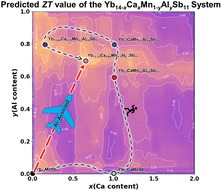
Traditional trial-and-error approaches for discovering and optimizing thermoelectric (TE) materials are exceptionally resource-intensive and labor-demanding. Recently, the Artificial Intelligence (AI)-guided methodologies have been applied to various materials to solve this type of issue. Thus, we present an AI-driven method to accelerate further optimization of the Ca14AlSb11-type TE material by exploring the quinary Yb14−xCaxMn1−yAlySb11 system, leveraging synergistic cationic Ca and anionic Al substitutions. Three Machine Learning (ML) models were developed and trained to predict TE properties (Seebeck coefficient, electrical conductivity, and thermal conductivity) as well as to screen the landscape for high figure-of-merit, ZT, composition. ML screening successfully identified several previously unreported candidates with promising predicted TE performance. Experimental validation confirmed that the four selected candidates were successfully crystallized in the tetragonal Ca14AlSb11-type structure. Electronic structure calculations indicated a higher effective mass upon co-substitution, resulting in enhanced TE properties. A maximum ZT of ca. 0.50 at 723 K was realized for the quinary Yb13.35Ca0.65Mn0.3Al0.7Sb11, which was a significant improvement over a ternary parent compound. This work successfully demonstrated that an AI-driven ML strategy can effectively navigate complex synthetic processes and accelerate the discovery of novel TE materials.
- This article is part of the themed collection: Journal of Materials Chemistry A HOT Papers
 Please wait while we load your content...


