


Polypyrrole-bridged vanadium oxide hierarchical microspheres for high-rate and durable aqueous Zn-ion storage

Abstract
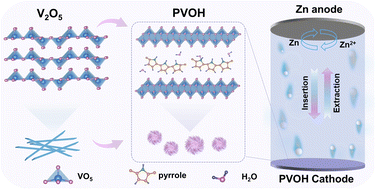
Vanadium oxides with rich crystal structures and multielectron redox capabilities are highly promising cathode materials for aqueous zinc-ion batteries (AZIBs). However, low electronic conductivity, high solubility, and sluggish kinetics limit their performance. To overcome these challenges simultaneously, we herein propose a novel “intercalation-polymerization-induced self-assembly” strategy to construct polypyrrole-intercalated hydrated vanadium oxide (PVOH) structures. Via a facile one-step hydrothermal process, the in situ polymerization of intercalated pyrrole triggers the reorganization of V2O5 nanobelts into robust, hierarchical microspheres. This unique architecture, with its internal conductive polypyrrole network, synergistically enhances electron/ion transport and physically suppresses vanadium dissolution, ensuring exceptional structural stability. Consequently, the as-prepared PVOH cathode delivers a high specific capacity of 437.8 mAh g−1 (at 0.2 A g−1) and remarkable rate capability of 351.2 mAh g−1 (at 10 A g−1). Moreover, it retains 70% of its initial capacity after 7000 cycles at a high current density of 10 A g−1, corresponding to an energy density of 395 Wh kg−1 at a power density of 180 W kg−1. This self-assembly strategy provides a new paradigm for the rational design of high-performance layered oxide cathodes for advanced energy storage applications.
- This article is part of the themed collection: Journal of Materials Chemistry A HOT Papers
 Please wait while we load your content...


