


Fluorinated surface-to-bulk engineering of sodium trititanate for developing sodium-ion batteries with high rate capability and long cycling life
 *a
*a
Abstract
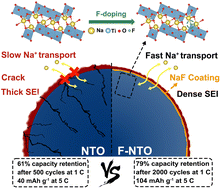
Layered sodium trititanate (Na2Ti3O7, NTO) is one of the most promising anodes for sodium-ion batteries (NIBs) owing to its merits of low charge potential and cost-effectiveness. However, it suffers from undesired interfacial reactions, sluggish Na+ transport kinetics and structural instability against cycling. Herein, a fluorinated surface-to-bulk modification strategy was applied to NTO, enabling surface NaF-coating and bulk F-doping, to enhance its rate capability and cycling stability. Experimental and computational calculation results demonstrated that F-doping lowered the bandgap energy of NTO and strengthened the Ti–F bonds, facilitating electron transfer and enhancing the structural stability against cycling. Meanwhile, the NaF-coating minimized electrolyte decomposition and facilitated the construction of a NaF-enriched SEI, which is beneficial for Na+ diffusion. As a result, the fluorinated electrode (F-NTO) exhibited a reversible Na+ storage specific capacity of 172 mAh g−1 at 0.1C and a high rate capability of 104 mAh g−1 at 5C. In addition, the F-NTO electrode delivered a long cycling life with 78.8% capacity retention after 2000 cycles at 1C, far outperforming the unmodified NTO electrode. This surface-to-bulk synergistic modification provides a robust approach to constructing high-performance titanate anode materials for developing super-charging and long-life NIBs.
- This article is part of the themed collection: Journal of Materials Chemistry A Emerging Investigators 2026
 Please wait while we load your content...


