


 PLATFORM UPDATE:


Highly reflective eco-friendly NIR cool pigments: properties and energy-saving in reflective cooling
 *a
*a
Abstract
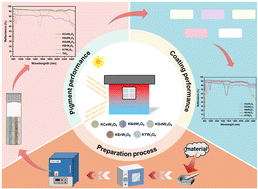
High near-infrared (NIR) reflective pigments demonstrate significant potential as thermal insulation materials. However, conventional pigments are constrained by aesthetic limitations, primarily monochromatic appearances (e.g., white) or the inclusion of heavy metals as well as performance deficiencies. In this study, a novel environmentally friendly cold pigment was developed using a rare earth ion full substitution strategy combined with high-temperature solid-state synthesis. This approach enables a one-step phase transformation from tetragonal to monoclinic crystal structures, resulting in materials that exhibit both chromatic diversity and superior thermal insulation performance. Among the synthesized materials, KYW2O8 achieved a solar NIR reflectance of 94.09% and an overall NIR reflectance of 92.51%, along with excellent chemical durability (ΔE* < 5 after acid and alkali exposure), and demonstrated effective surface cooling in experimental evaluations. Building energy simulations revealed that the application of KYW2O8 coatings in various climate zones across China could yield an average annual cooling energy saving of 58.13 MJ m−2, with a maximum HVAC energy reduction of 105.87 MJ m−2 per year observed in office buildings in Nanning. This research presents a promising pathway for advancing high-performance thermal insulation materials, aligning with strategic objectives of energy conservation, emission reduction, and sustainable development.
 Please wait while we load your content...


