


 PLATFORM UPDATE:

Interstitial anionic electrons as spin–charge reservoirs for sterically tuned single-atom catalysis in 2D electrides
 ab
and
Jin-Ho
Choi
*ab
ab
and
Jin-Ho
Choi
*ab
Abstract
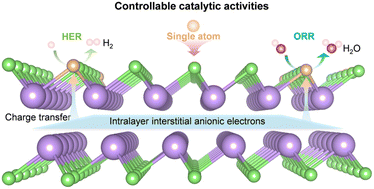
Two-dimensional van der Waals (vdW)-stacked electrides host interstitial anionic electrons (IAEs) confined within atomic layers, unlike ionically stacked electrides where IAEs occupy interlayer spacings. This intralayer confinement enables distinctive charge-transfer behaviors, while weakened interlayer binding facilitates exfoliation and enhances stability. Using first-principles calculations, we show how defect engineering modulates IAE states in monolayer XCl electrides (X = Sc, Y, La), precursors to vdW-stacked multilayers. Vacancies expose spin-polarized IAEs near the surface, increasing reactivity but reducing air stability. Introducing single-atom dopants into these vacancies suppresses IAE delocalization and modulates the local electronic structure through spin-polarized charge transfer. Although the dopant's electron-accepting tendency contributes, steric effects typically dominate: larger dopants lie farther from IAE reservoirs, diminishing spin/charge uptake, whereas smaller dopants permit more. This steric mechanism provides a practical handle for coarse control of charge and spin transfer, exemplified by the tuning of H and OH adsorption. In this context, we introduce a descriptor, Δq—defined as the absolute charge exchanged between the adsorbate-dopant unit and the XCl host—which shows a linear correlation with adsorption energetics. This correlation indicates that orbital hybridization proceeds concertedly across the system, with charge transfer largely mediated by the IAE reservoir. As a result, the IAE exerts a substantial influence alongside dopant selection in governing catalytic energetics in 2D electrides, suggesting its broader significance for single-atom catalysis.
- This article is part of the themed collection: Journal of Materials Chemistry A HOT Papers
 Please wait while we load your content...


