


Mixed-valence engineered bipolar polyimide covalent organic framework film for multicolor displays and dual-band electrochromism

Abstract
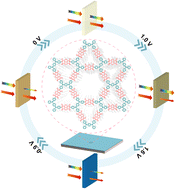
Dual-band electrochromic materials can selectively modulate the absorption or transmission of light, enabling effective photothermal regulation of solar radiation. However, existing materials face limitations in achieving multicolor switching and fully independent modulation of visible (VIS) and near-infrared (NIR) light. Herein, we report a COF film capable of multicolor display and independent VIS/NIR control, realized through a mixed-valence engineering strategy based on bipolar units. The bipolar units exhibit independent electrochromic behavior across a broad voltage range, enabling switching between four distinct color states (translucent, turquoise yellow, dark blue, and brown). Furthermore, voltage-controlled formation and loss of mixed valence in the TPPDA unit modulates the NIR absorption profile (900 nm, ΔT = 53%), allowing independent regulation of VIS and NIR transmission. A dual-band electrochromic smart window (DESW) device fabricated from the TPPDA-PI COF film demonstrates reversible switching between four photothermal modes: “bright”, “cool”, “dark”, and “warm”. Underscoring the potential of bipolar PI COF film as a promising molecular design strategy for high-performance dual-band electrochromic materials in building energy conservation.
 Please wait while we load your content...


