


 PLATFORM UPDATE:


Photothermal–excitonic trade-off in TiO2/BiCuSeO heterojunctions for optimal solar-driven hydrogen production

Abstract
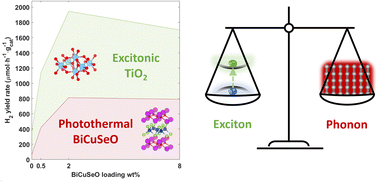
Photocatalytic hydrogen production driven by solar energy presents a promising route for sustainable energy conversion. Yet, the benchmark photocatalyst TiO2 is constrained by limited harvest of visible and infrared (IR) light and kinetically sluggish surface reactions. Here, we combine TiO2 with bismuth copper oxyselenide (BiCuSeO), an oxygen-rich phonon-glass electron-crystal (PGEC) oxychalcogenide that features broadband absorption, electron-phonon interaction, and strong phonon–phonon scattering, collectively enabling effective light-to-heat conversion to create a photothermal–excitonic hybrid catalyst. TiO2/BiCuSeO composites with controlled BiCuSeO loadings (0.5, 2, and 8 wt%) were synthesized to elucidate how photothermal input from BiCuSeO competes with and complements TiO2 excitonic processes, thereby synergistically promoting water splitting. The optimal 2 wt% composite delivers a hydrogen evolution rate of 1946 µmol h−1 g−1, corresponding to a 6.55-fold enhancement over pristine TiO2 (297 µmol h−1 g−1). Optical, electrochemical, and (photo)thermal characterization studies show that the activity enhancement is dominated by localized photothermal heating that accelerates interfacial kinetics, rather than by improved charge separation, as is typically associated with heterojunction photocatalysts. Notably, increasing BiCuSeO loading beyond 2 wt% yields no further gains, underscoring a compositional trade-off, as an excessive photothermal contribution can erode exciton-driven photocatalysis. These results identify composition as a key design lever for balancing photothermal-photocatalysis coupling, making it a viable strategy for sustainable solar-to-hydrogen conversion.
- This article is part of the themed collection: Advanced Nanomaterials for Sustainable Green Hydrogen Production
 Please wait while we load your content...


