


Decahedral platinum–copper nanoframes enriched with defects for highly efficient electrocatalytic hydrogen evolution reaction

Abstract
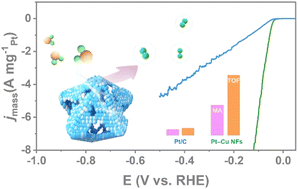
Defect engineering plays a pivotal role in tuning the surface reactivity of nanomaterials, making it a significant research field in enhancing performance of the electrocatalytic hydrogen evolution reaction (HER). However, controlling the diversity of defects within nanocrystals and elucidating their impacts on the catalytic activity remain great challenges. Herein, highly open Pt–Cu nanoframes (Pt–Cu NFs) featuring penta-twinned structures, dislocations, and atomic steps are explored. This unique architecture enhances exposure of active sites to a great extent and facilitates H* adsorption and H2 desorption. Impressively, the Pt–Cu NFs merely require an overpotential of 10 mV to achieve a current density of 10 mA cm−2 for the HER and exhibit outstanding stability exceeding 500 h in 0.5 M H2SO4. Additionally, the mass activity (MA) and turnover frequency (TOF) of the Pt–Cu NFs are 9.0- and 17.1-fold higher than those of commercial Pt/C at an overpotential of 100 mV, respectively. Density functional theory (DFT) calculations indicate that the electronic interaction between Pt and Cu results in a downshift of the d-band center which in turn optimizes the hydrogen adsorption energy at Pt sites. This work demonstrates that the fabrication of nanoframe architecture with diverse defects presents an effective approach to design high-performance HER electrocatalysts.
 Please wait while we load your content...


