


Cr(vi) reduction mediated by hydrogen radicals generated from formic acid dehydrogenation on tailored Ni-based catalysts: mechanisms, progress, and perspectives
 *b
Jingquan
Liu
*bc
*b
Jingquan
Liu
*bc
Abstract
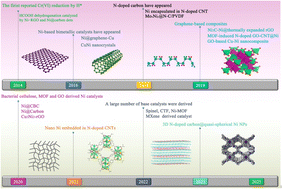
The remediation of Cr(VI) in industrial wastewater remains a critical challenge due to its high toxicity and environmental persistence. Among emerging strategies, the active hydrogen radical (H*)-mediated reduction of Cr(VI) to less mobile and less toxic Cr(III) has attracted considerable attention for its high efficiency, mild reaction conditions, and environmental compatibility. HCOOH serves as an ideal hydrogen carrier, capable of generating H* via catalytic dehydrogenation, thus offering a sustainable and effective pathway for Cr(VI) detoxification. Ni-based catalysts have emerged as particularly promising candidates for this process, owing to their low cost, earth abundance, high catalytic activity, and electronic structure analogous to noble metals such as Pd, all of which facilitate efficient HCOOH activation. This review systematically summarizes recent advances in Ni-based catalysts-including graphene, MOF, COF, MXene, spinel, polymer, and bimetal derived materials-for Cr(VI) reduction via HCOOH dehydrogenation. We critically evaluate the structural design, synthesis methodologies, and catalytic performance of these materials, with particular emphasis on the roles of support interactions, nitrogen doping, and metal dispersion in enhancing activity and stability. Furthermore, mechanistic pathways involving H* generation, HCOOH activation, and electron transfer processes are elucidated by experimental and theoretical insights. Current challenges, such as catalyst stability under harsh conditions, precise control of active site distribution, and the scalability of advanced materials synthesis, are discussed in depth. Finally, forward-looking perspectives are provided on the integration of computational screening, advance in situ characterization, and sustainable material design to guide the development of next-generation Ni-based catalysts for Cr(VI) remediation.
- This article is part of the themed collection: Journal of Materials Chemistry A Recent Review Articles
 Please wait while we load your content...


