


Grafting self-assembled monolayers on polymeric substrates toward Li3N-stabilized solid electrolyte interphases

Abstract
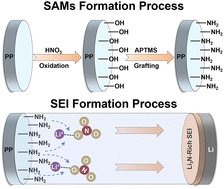
Self-assembled monolayers (SAMs) provide a powerful molecular-level bottom–up regulation strategy for addressing the interfacial instability of lithium (Li) metal batteries, yet their application is generally limited to inorganic substrates. Herein, we developed a facile and universal grafting strategy to directly construct stable amine (NH2)-terminated SAMs on polymer separators without the need for inorganic coatings. Specifically, we introduced hydroxyl groups to polypropylene (PP) separators through chemical oxidation modification. 3-Aminopropyltrimethoxysilane molecules were then covalently anchored onto the oxidized PP separators to form densely packed and highly oriented NH2-SAMs. The resulting strong dipole moments enhance the reduction of the electrolyte additive LiNO3, leading to the formation of a Li3N-rich solid electrolyte interphase. The SAM-modified separators enable long-term stable cycling in Li|Li symmetric cells for 1200 h due to the stable interface, and are validated in both LiFePO4|Li and high-loading LiNi0.8Co0.1Mn0.1O2|Li full cells. This work advances SAM-based interfacial engineering and provides a general molecular-level design paradigm for stabilizing Li metal anodes.
- This article is part of the themed collection: Journal of Materials Chemistry A HOT Papers
 Please wait while we load your content...


